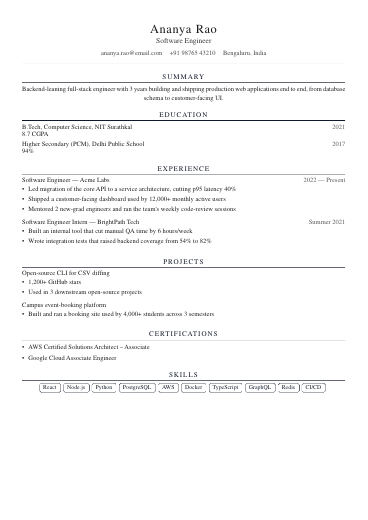
What to include (in this order)
- 1
Contact details
Name, phone, email, city, LinkedIn or portfolio.
- 2
Profile summary
Three lines on your field, experience and strengths.
- 3
Education
Degrees with institution, year and score; for academic CVs add thesis titles.
- 4
Experience
Roles in reverse-chronological order with achievements.
- 5
Research & publications
For academic or research CVs: papers, conferences, patents.
- 6
Skills & certifications
Technical skills, tools, languages and courses.
- 7
Awards & activities
Scholarships, ranks, competitions, leadership roles.
Sample bullet points
- Published 2 papers on machine learning for crop-yield prediction in peer-reviewed conferences.
- Awarded university merit scholarship for being in the top 2% of the M.Sc batch.
- Taught undergraduate lab sessions for 3 semesters as a teaching assistant (60+ students per batch).
- Led a 5-member team that won a state-level innovation challenge.
Tips that make a difference
- For most private-sector jobs, send a 1–2 page resume even if the post says 'CV'.
- Use a full academic CV for PhD, research, teaching and fellowship applications.
- Keep formatting consistent: same date style, same heading style throughout.
- List the newest items first in every section.
Skills you can list
SahiResume
Let AI write it. You pick the look.
No login · from ₹10 · real PDF preview before you pay
Build this resumeFrequently asked questions
Is a CV the same as a resume in India?+
In everyday use, yes. Technically a CV is a complete, longer record (used in academia) and a resume is a short, tailored summary.
How long should a CV be?+
A job CV/resume should be 1–2 pages. An academic CV can be longer because it lists publications and research.
Which format is best for freshers?+
A one-page, single-column resume format with education and projects first.